

Significant Progress Made in Research on a New Mechanism of Radiation Resistance in Liver Cancer
Recently, an international team of researchers, led by Professor Cao Jianping from the Center for Radiation Biology at the School of Radiological Medicine and Radiation Protection, Suzhou Medical College of Soochow University, in collaboration with a team led by Professor Cheng Shuqun from the Third Affiliated Hospital of the Naval Medical University, has made significant progress in its research into the mechanisms of radioresistance in hepatocellular carcinoma. The findings were published in the British Journal of Cancer under the title “The Rac1-USP11 feedback amplification loop: a radiation-activated engine driving radioresistance in hepatocellular carcinoma.” The paper can be accessed via the following link: https://doi.org/10.1038/s41416-025-03265-1.
Radiation resistance constitutes an objective biological factor with the capacity to affect the clinical efficacy of radiation therapy for hepatocellular carcinoma (HCC). Nevertheless, the underlying mechanisms remain to be fully elucidated. The present study established that elevated levels of the active form of Rac1 (Rac1-GTP) in patients with liver cancer undergoing radiation therapy are indicative of a poor response to such treatment. Mechanistic studies have revealed the activation of Rac1 by ionizing radiation (IR) and the consequent induction of its nuclear translocation. This process, in turn, triggers the transcription of the key deubiquitinating enzyme USP11. The newly synthesized USP11 then stabilizes Rac1-GTP through the process of deubiquitination, thus forming a self-reinforcing Rac1-USP11 positive feedback amplification loop that drives radiation resistance in HCC. Furthermore, the study determined that the suppression of USP11 or the mutagenesis of Rac1 deubiquitination sites (K123/K147/K183) resulted in the disruption of both the stability of Rac1-GTP and the reversal of radiation resistance in HCC.
Subsequent to these mechanistic findings, the team proceeded to validate the feasibility of the combined targeted therapy strategy. The study confirmed that the combination of the Rac1 inhibitor NSC23766 and the USP11 inhibitor mitoxantrone demonstrated enhanced radiosensitization effects both in vitro and in vivo. In a xenograft tumour model, the combination therapy exerted a more significant inhibitory effect on tumour growth and radiation resistance than treatment with a single inhibitor. This finding reveals a new mechanism underlying radiation resistance. In addition, it provides an important theoretical foundation and experimental basis for the future development of specific small-molecule inhibitors targeting USP11 and Rac1-GTP. These findings offer a promising therapeutic strategy for enhancing radiation sensitivity in HCC.
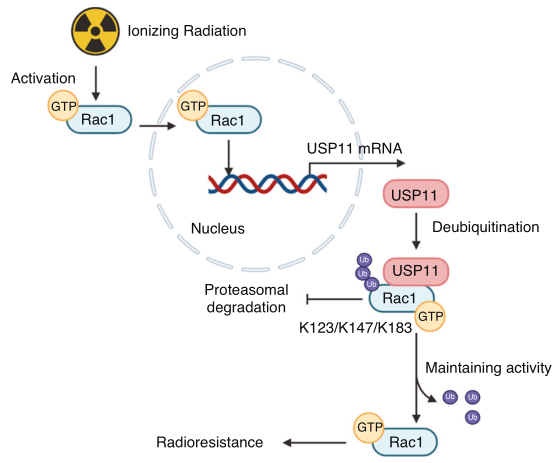
Figure 1. Schematic diagram illustrating the mechanism by which the Rac1-USP11 feedback amplification loop drives radiation resistance in HCC.
The authorship of this paper is shared by Professors Jiao Yang and Cao Jianping from the School of Radiological Medicine and Protection at Suzhou Medical College, Soochow University, and Professor Cheng Shuqun from the Third Affiliated Hospital of the Naval Medical University. The research was supported by the National Key Research and Development Program (2022YFC2503700, 2022YFC2503703) and the National Natural Science Foundation of China (82103483, 82102941), among other projects.