

Significant progress has been made by Prof. Chang Lei's team and their collaborators in understanding the mechanisms of radiation-induced liver injury
Recently, the team led by Professor Chang Lei at the State Key Laboratory of Radiation Medicine and Protection, Soochow University, and their collaborators published online in Journal of Hepatology (IF = 33), a top international journal in hepatology, a study entitled “Chromatin remodeling in pericentral hepatocytes modulates MASH through CYP450 activity.” This study systematically reveals a novel mechanism by which the chromatin remodeling factor DPF2 in Lgr5⁺ hepatocytes surrounding the central vein of the hepatic lobule regulates CYP450 metabolic enzyme activity and the balance of all-trans retinoic acid (atRA), thereby influencing the development and progression of radiation-induced liver injury and metabolic dysfunction-associated steatotic liver disease (MASLD). The findings provide an important theoretical basis for understanding the pathogenesis of radiation-induced liver injury and MASLD/MASH and for clinical intervention. Paper link: https://www.journal-of-hepatology.eu/article/S0168-8278(26)00190-X/fulltext.
Leucine-rich repeat-containing G protein-coupled receptor 5 (Lgr5) is generally regarded as a stem cell marker in actively self-renewing tissues, and its function in the liver has long been controversial. Early studies once proposed that Lgr5⁺ hepatocytes possess liver stem cell properties, but subsequent studies gradually revised this view, confirming that these cells have limited roles in liver homeostasis maintenance and tissue regeneration and mainly maintain their own lineage; however, their specific physiological functions and pathological significance have not been fully elucidated. The liver uses the lobule as its basic functional unit and shows marked metabolic zonation from the portal vein to the central vein. Although Lgr5⁺ hepatocytes around the central vein account for only 3%–5% of total liver cells, they participate in nutrient metabolism and the progression of liver diseases. How such a small population of cells regulates the overall metabolic state of the liver has remained a key unanswered scientific question in the field.
In this study, the team comprehensively used genetically engineered mouse models, single-cell transcriptomics, spatial transcriptomics, chromatin accessibility analysis (ATAC-seq), and epigenetic modification detection (CUT&RUN, CUT&Tag) to systematically dissect the function of DPF2, a key subunit of the SWI/SNF chromatin remodeling complex, in Lgr5⁺ hepatocytes. The study found that loss of DPF2 in Lgr5⁺ hepatocytes significantly increases chromatin accessibility and activating epigenetic modifications in the promoter regions of CYP2 family metabolic enzyme genes, thereby enhancing CYP2-mediated catabolism of atRA. Decreased hepatic atRA levels reduce AMPK phosphorylation, making it unable to effectively maintain lipid metabolic homeostasis, ultimately significantly exacerbating diet-induced hepatic lipid deposition, inflammation, and steatohepatitis lesions. The study also observed that Lgr5⁺ hepatocyte-specific DPF2 knockout mice exhibit a clear phenotype of radiation-induced liver injury, suggesting that this mechanism is of common importance in radiation injury and metabolic liver disease. This finding also provides an important methodological insight for liver disease research, suggesting that conventional bulk omics or whole-liver genetic manipulation may mask key mechanisms by which spatially restricted cell populations drive disease. This work not only deepens the understanding of Lgr5⁺ hepatocyte function but also provides potential intervention strategies, such as atRA supplementation, CYP2 enzyme inhibition, and AMPK activation, for the prevention and treatment of radiation-induced liver injury and metabolic dysfunction-associated steatotic liver disease.
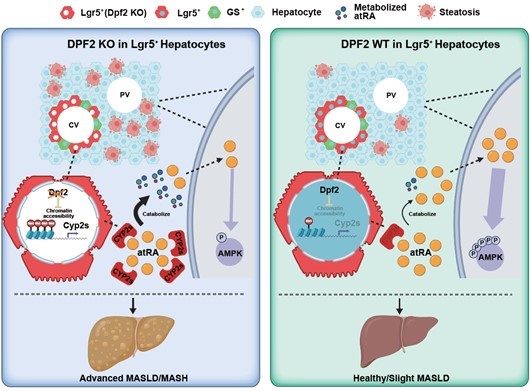
The study was conducted with the State Key Laboratory of Radiation Medicine and Protection, Soochow University, and the School of Radiation Medicine and Protection, Soochow University, as the first affiliations. Zhang Zhisen, a doctoral student at the School of Radiation Medicine and Protection, Soochow University; Lu Shuangshuang, a master’s student; and Shu Yinyin, a postdoctoral fellow at Fudan University, are co-first authors. Professor Chang Lei of the State Key Laboratory of Radiation Medicine and Protection, Soochow University; Professor Shao Chunlin of Fudan University; and Professor Chen Xi of the Southern University of Science and Technology are co-corresponding authors.
Journal of Hepatology is the official flagship journal of the European Association for the Study of the Liver (EASL), published by Elsevier, and focuses on publishing the highest-quality basic, translational, and clinical research in hepatology. Its 2025 impact factor is 33.0; it ranks Q1 in JCR Gastroenterology & Hepatology (3/147 globally, top 2%) and is a Category 1 Top journal in Medicine under the Chinese Academy of Sciences partition. With a CiteScore of 48.5 and an h-index of 319, it is internationally recognized as a benchmark top journal in hepatology. Its published findings lead the direction of the discipline and inform clinical guidelines, representing the highest global level of hepatology research.